Saturday, June 10, 2017

The sorry plight of the unprotected small investor

The system of directed loans to crony capitalists makes the plight of the individual saver/investor a sorry one indeed. Recently, depositors of a bank called Kapol Bank, which was shut down, were informed that they would get back only ₹1 lakh, irrespective of the amount they had deposited with the bank. This is called a ‘bail in’, as opposed to a ‘bail out’, under which the depositors are rescued, or bailed out, by the government pumping in more (taxpayer) money. So, instead of the taxpayer, it is the depositor who suffers.
There are seven PSU banks which are on the RBI watch-list for Prompt Corrective Action. If any bank from this list is directed to go for a bail in, and depositors lose their deposits, it will cause a panic. Most likely, they will be merged with larger banks to protect depositors.
‘Sadim’ touch
Why did things come to this stage? Basically because of what this columnist calls the ‘Sadim’ touch, which is the opposite of the ‘Midas’ touch. Everything King Midas touched in the fable, turned to gold; in the hands of the government however, thanks to interference by politicians, gold turns to dross. Think of banks. Think of textile mills (it was land appreciation that saved them). Think of Air India. So bank deposits are not safe; GTB, a private bank, went bust and had to be merged with OBC. Yet the small depositor has to periodically submit to know your customer (KYC) norms and repeat the process for each institution. Why?
The small saver also has to bear random charges imposed unilaterally by banks, which justify the action as being necessary to service their investors. Banks can raise from depositors/lenders up to nine times the amount of funds it can from shareholders. Yet people like Aditya Puri justify charges on depositors by stating that they need to service shareholders!
So, is a small investor better off investing in an equity mutual fund? Marginally so. Those with a longer memory would recall that they were unfairly hit when the US64 scheme (of the Unit Trust of India) was restructured and the promised repurchase price lowered. The then government transferred shares in three valuable companies (ITC, Axis Bank and L&T) to itself. These three have significantly appreciated, but the small unit-holders who were short-changed are not getting anything from the sale of these three companies; the proceeds will go to the government.
Private sector mutual funds are better. But, as a large chunk of the fund manager’s pay is linked to performance, all mutual funds behave in more or less similar manner. In the US, a majority of them underperform the index. This has led to the rise of passive funds, or ETFs.
The whole system acts against the interest of the small investor. The investigative agencies water down the investigation, by allowing crucial papers to slip out of their greased palms. It is only four years later that the government is ordering a forensic audit of the ‘crashed’ computers of NSEL and FTIL. Why does it take four years to do the obvious? The answer should be obvious. The government must do more to protect the individual investor and hand out exemplary punishment to scamsters, in order to deter others.
J MULRAJ
(The writer is India Head — Finance, Asia/Haymarket. The views are personal.)
(This article was published on June 9, 2017)

Monday, June 5, 2017

Why ‘new’ knee isn’t the final answer

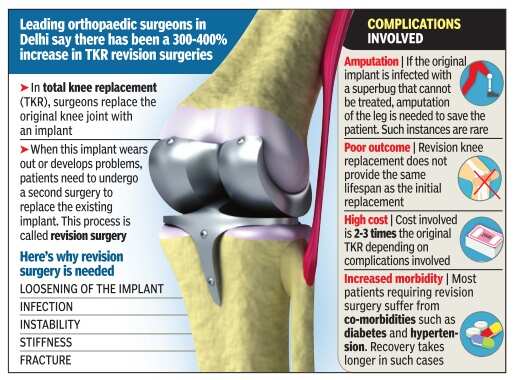
New Delhi: Total knee replacement (TKR) surgeries have gone up by 100% in the country over the past five years, but the rate of revision surgeries for TKR has grown even faster.

Leading orthopaedic surgeons said that there has been a 300-400% rise in such surgeries due to increased incidence of infection in the implants, followed by loosening, instability and fractures.

“In 2006, we used to conduct 12 to 13 TKR revisions annually of which 8-10% were for infection. In 2016, the numbers were three to four revisions monthly in which 80% were for infection, 15% for loosening and instability, and the remaining 5% for fractures,” said Dr Rajesh Malhotra, professor and head of orthopaedics department at AIIMS, adding that one-third of all the revisions required bone graft from a donor.

Dr Ramneek Mahajan, director, orthopaedic and joint replacement at Max Smart Super Specialty Hospital, Saket said five years ago he did a couple of revision surgery every month, but the number has now gone up to 4-5 cases monthly (roughly 50 cases annually).

Dr Ajay Gupta, Dr Ashok Rajgopal and Dr Yash Gulati, who head the orthopaedic unit at Lok Nayak, Fortis-Escorts and Apollo Hospital respectively, also confirmed the trend.

TKR, conducted mostly on patients suffering from age-related arthritis, involves replacing natural joints with mechanical ones. When this implant wears out or develops a problem, patients are required to undergo a second surgery to replace the existing implant, which is referred to as revision surgery.

Doctors said revision surgery is more complicated than the initial operation as it involves the removal of the old prosthesis and insertion of a new one.

In addition, since tissues grow around the old knee replacement prosthesis, extracting it safely becomes a challenge.

“Most patients catch infection during implants at hospitals as sterility methods are not up to the mark in the peripheral hospitals. These are caused by bacteria, sometimes superbugs, which are difficult to treat with the best antibiotics. We have seen cases where a leg had to be amputated to save the life of a patient,” said Dr Rajgopal.

Another complication of the revision surgery is shorter lifespan. While a primary TKR provides for a lifespan of 15 to 20 years, revision surgery provides only up to 10 years.

Explaining the reasons behind the increase in revision surgery, Dr Gupta of Lok Nayak Hospital said, “Many surgeons with limited skill-set and infrastructure support have started conducting joint replacements as it is lucrative. If the implants are not aligned correctly, revision surgery may be required sooner. Also, poor infrastructure in operation theatre increases the risk of acquired infections that are difficult to treat.”

Experts said TKR in younger patients must be avoided as the chances of revision surgery were higher in them.

“Nearly 30-35% of knee replacements conducted in the country are unnecessary. At AIIMS, we have been holding awareness programmes to educate patients about the need to focus more on lifestyle modification than surgeries,” said Dr C S Yadav, professor of orthopaedics, AIIMS.

Why ‘new’ knee isn’t the final answer

Saturday, June 3, 2017

India has 31% of world’s poor kids: report


About 31% of the world’s “multidimensionally poor” children live in India, according to a new report by the Oxford Poverty and Human Development Initiative (OPHI), a poverty reduction project grounded in economist Amartya Sen’s ‘capability approach’.

“In terms of countries, fully 31% of the 689 million poor children live in India, followed by Nigeria (8%), Ethiopia (7%) and Pakistan (6%),” noted the survey, titled ‘Global Multidimensional Poverty Index [MPI], 2017’. OPHI is an economic research centre at the Oxford University, led by Professor Sabina Alkire, and the study is based on a survey conducted among 103 countries.

A “multidimensionally poor” child is one who lacks at least one-third of ten indicators, grouped into three dimensions of poverty: health, education and standard of living. The health dimension comprises indicators such as nutrition, child mortality, and education. Under standard of living are indicators such as access to cooking fuel, improved sanitation, safe drinking water, electricity, flooring, and asset ownership.

In terms of the number of such multidimensionally poor children as a proportion of the total population, India stood 37th among 103 countries. Out of India’s 217 million (21.7 crore) children, 49.9% were multidimensionally poor. However, the survey pointed out that the data for India were “somewhat outdated”, being based on the Indian Human Development Survey of 2011-2012.

Staggering number

“In terms of absolute numbers, India accounts for both the highest and a staggering number of multi-dimensionally poor people. Sadly, more than 528 million (52.8 crore) Indians are poor, which is more people than all the poor people living in Sub-Saharan Africa combined,” the survey noted. It further stated that nearly 50% of the children in 103 countries were multidimensionally poor.

“Of the 1.45 billion (145 crore) people (from the 103 countries) who are multidimensionally poor; 48% are children. That is a total of 689 million (68.9 crore) children who live in multidimensional poverty,” said thereport. According to the study, 87% of the multidimensionally poor children lived in South Asia (44 percent) and Sub-Saharan Africa (43%). “In Ethiopia, Niger, and South Sudan, over 90 % of the children are MPI poor,” it stated.

As for the intensity of poverty, the average percentage of deprivation in terms of the 10 MPI categories was highest in Sub-Saharan Africa, where multidimensionally poor children were “simultaneously deprived” in 58% of the indicators. Sub-Saharan Africa was followed by the region described as the Arab States (53%). South Asia occupied the third spot, with children deprived in 49% of the MPI indicators.

Describing the findings as “deeply disturbing”, the director of OPHI Sabina Alkire said, “This is a wake-up call to the international community which has adopted the global Sustainable Development Goals and takes seriously Goal 1, the eradication of poverty in all its forms and dimensions.”

Toiling for a toilet


On June 15, 2016, just off a train ride 1,000 miles south from a brick kiln in Punjab, Ramlal Baghel, along with three of his sons and their wives, arrived home to their village in rural Chhattisgarh, fatigued and disappointed. Five months of gruelling 15-hour days had netted the family just ₹26,000. The earnings would have barely been enough to sustain the family until the kilns reopened in September — let alone chip away at the growing debt.

So far it was a familiar story. Now in his 60s, tall and thin, with deep-set eyes and a peppered beard, Ramlal is one of a million-or-so Chhattisgarhis compelled by debt, local unemployment, and interest-free “advances” to migrate to notoriously exploitative kilns across India’s northern rim. But as the Baghels settled in at home for the rainy season, a notice arrived ordering each family in the village to construct a toilet as part of a national government sanitation scheme. Non-compliance would incur huge fines and suspended entitlements.

“Whatever I made at the brick kiln, it went towards making the toilet,” said Ramlal. He pointed to the small dirt courtyard at a latrine the size of a small closet. It had a fresh yellow coat of paint, corrugated tin roof, PVC door, and squat pan toilet inside. It was clean, new and deceivingly innocent-looking.

While sanitation schemes in India date back to the British Raj, Swachh Bharat Mission (SBM) is the latest and by far most ambitious iteration. Launched by India’s Prime Minister Narendra Modi at the end of 2014, the ₹9,000-crore scheme aims to achieve an Open Defecation-Free (ODF) India by constructing 12 million rural household toilets across the country before October 2, 2019 — to coincide with Mahatma Gandhi’s 150th birthday.

But in mid-December, a visit to 28 villages in Janjgir-Champa, considered the district in Chhattisgarh with the most migrant brick labourers, revealed that SBM had become a means to a different end. Interviews with over 100 villagers and lower-level government officials across Malkharoda block, where the Baghels and some 1,40,000 people live across 108 villages, revealed an utterly botched rollout. Systemic coercion had induced rampant debt. No one would take responsibility. This seemingly benevolent sanitation scheme meant to make women safer and prevent diseases had instead perpetuated migratory forced labour.

Opening the door to coercion

Travelling around Malkharoda, the coercion appears widespread. In every village administrators had threatened to revoke the families’ ration cards — their most essential entitlement — if they didn’t build the toilets. In all but one village, guards had been stationed on the roads at night to shame women who were out to relieve themselves; women said they blew whistles, knocked over their water jugs, and one man said they assaulted people. In at least one village, the poorest people were told their mud kutcha houses would be razed if they didn’t comply. And in a handful of villages, fines ranging from ₹50 to ₹1,000 were instated for anyone caught out in the bush.

In Malkharoda village, the dhaba owner said that the Janpath chief executive officer, Vinay Kumar Soni, beyond threatening to shutter her restaurant if she didn’t get the toilet built, had threatened to take photos of her relieving herself and post them on the Internet. Perhaps this was just an easy, empty threat. But the next day in Runpota village, a young man named Digeshwar Baragi said the village secretary had actually taken his photo while he was out relieving himself and circulated it among other village secretaries on WhatsApp.

“I found it very humiliating,” said Baragi, a bandana tied around his forehead. “And I told him ‘I don’t have any money, how do you expect me to get [the toilet] made?’ But he wasn’t bothered and said if I don’t get it built fast, he was going to circulate it on the Internet as well. They’ve done it among my friends too. And the girls.” Baragi had taken out a ₹20,000 loan at 3% interest, and the toilet still wasn’t finished.

These coercive tactics, beyond being outright illegal, are all degrading distortions of perhaps the biggest lesson learned from decades of rural sanitation work across the globe: simply building people toilets doesn’t mean they’ll use them. More crucial and challenging is inducing communal behavioural change. Since the 1990s, the prevailing technique that’s been used in India and much of the developing world is called Community-Led Total Sanitation (CLTS). In short, CLTS advocates introducing the feeling of shame and disgust to a community through a series of “triggering” activities in order to induce the abandonment of open defecation.

Under SBM, the Indian government suggests (and earmarks funds so that) each panchayat train an “army of ‘foot soldiers’” under the command of a “motivator” to trigger villages into abandoning open defecation. If you only followed the government’s highly active and curated @swachhbharat Twitter account, triggering across the country looks like a pleasant affair: photos of villagers actively participating in defecation area mapping exercise; smiling women and children leading awareness marches.

And while the majority of triggering likely stays within the ethical bounds of CLTS guidelines, Malkharoda is not the first place where it hasn’t. Coercive techniques have been documented at CLTS programmes in Indonesia and Bangladesh, and in India, at least in the southern State of Karnataka, but likely in other States as well. In an online sourcebook of practical SBM campaign ideas written for administrators, a cautionary note under the sub-header “reflect on ethical issues” admits to a dozen coercive tactics and outright human rights abuses that “have occurred in some campaigns”.

Digging into debt bondage

Nonetheless, the coercion had accomplished its goal in Malkharoda. Everyone seemed to have a toilet. The entire block was officially declared ODF in mid-2016. The problem now was that beyond the ethical implications, everyone was in debt.


In Amlidih, the sarpanch, or village mayor, gave out materials initially, but then stopped without explanation. “We were waiting,” said Balash Prasad Chandra, “expecting him to give [materials] to us as well.” Instead, he said the local panchayat held a meeting and told everyone to build the toilets themselves, and fast, or else their ration cards would be cancelled.

The timing couldn’t have been worse. Chandra was in the midst of building his family a house and owed a shopkeeper for materials he had taken on credit. Now, to pay for the toilet too, he had to sell off his paddy stocks, pawn his wife’s jewellery, and take out a ₹45,000 loan at 3% interest. “I spent the entire season’s income on this toilet,” he said. “Whatever we make on this year’s harvest, I’m going to have to spend to get her jewellery back.”

Still, Chandra had it better than some. He owned some land, and worked as the local confectioner, taking sweets orders for weddings that brought in a few thousand rupees per month — an income that’s kept him from the kilns. But the vast majority of lower-caste people in Janjgir possess little to no land nor specialised skills. Most work as field hands but describe employment as a day-to-day crapshoot. Across the block, people said they had pawned or sold their wives’ jewellery, land if they had any, and taken high-interest loans from wealthy landowners which would take years to pay back.

But even worse, in Bade Sipat, where about 90% of the 3,300-person village migrates out to kilns, a street vendor named Visham Kurana made it clear the debt was perpetuating their migration. “Whatever money they had made at the kilns [this past season], they’ve spent to make this toilet,” Kurana said. “So again to run their families, they have taken loans at high interest” — ₹50,000 at 5% on average — “and some have even taken money from the jamadars (middlemen) who take them to the brick kilns, so now they have to work like bonded labourers.”

Still, the price tag was confounding. For one, the government and UNICEF consider the ₹12,000 “incentive” allocated per household sufficient to construct a long-lasting toilet. (In Chhattisgarh and other States this “incentive” was in fact a ‘reimbursement’ since it was being disbursed after the entire village or block went ODF.) Gramalaya, an NGO that’s been building toilets in India for decades, claims it can build a child-friendly community bathroom — with 10 latrines, washing stations, and murals — for about ₹30,000.

For another, even though the SBM guidelines recommend individual households construct their own toilets to “promote ownership”, many sarpanches had built the toilets in their village; and when they did, each unit had cost around the quoted ₹12,000. Why were poor villagers, many already in significant debt like Ramlal, spending two to three times as much on a toilet they didn’t want in the first place?

Blame and stigma

When I put this question to a handful of lower-level administrators around the block, they offered a few theories to explain the discrepancy, all of which held villagers responsible. The first — expressed by Pirda’s sarpanch and an MNREGA employment assistant officer from Nawapara-D — simply held that villagers were lying about the high construction expense.

The second theory — expressed by Shivanti Lakshmibai Johan, the sarpanch of Ghoghri, among others — held that villagers were willingly spending extra. She had constructed toilets in 80% of the village for the allotted ₹12,000 each. But there had been a minority of villagers who had spent extra to make their own toilets “bigger and better”, with tiles, painted walls, and stylised doors. Surely there were villagers who spent more to deck-out their toilets, perhaps some irresponsibly. But predominantly, the toilets constructed by villagers looked pretty much identical to those constructed by the sarpanch, at least outwardly in size and material.

In Khurgatti, the de facto sarpanch Kishur Kumar Ajay at first echoed Johan. But upon seeing a photo of a toilet that a villager had spent upwards of ₹30,000 to construct, he conceded it looked almost identical to the toilets he had constructed for ₹12,000. He pivoted to a more technical theory about pit design. In his village, he had used the government-encouraged twin-leach pit technology. Villagers constructing their own toilets were digging one single deep pit, he said, which hiked the raw material and labour cost.

According to the SBM guidelines though, “Care shall be taken to ensure that these toilets are not over-designed and over-constructed. I.e. building extra large pits which are not required, to keep them affordable…States have to ensure through effective communication that such tendencies are restricted.” Ajay shook his head upon hearing the passage. “It’s actually totally the villagers’ responsibility what kind of designs they have used. We’ve conducted enough programmes to educate them on how to keep the cost at ₹12,000.” He continued, “Their thought might be that whatever resources they have, they can just pawn for now and make a good toilet instead of re-channelling the pits again and again.”

This theory seemed plausible: for a blend of religious, cultural, and habitual reasons, villagers were already apprehensive about placing their waste so close to their homes. Requesting they also manage that waste every couple of years — by clearing the filled pit and rerouting the pipe — seemed like a steep sell. Steeper still by a government many distrusted to begin with. We did come across villagers who had opted for one single deep pit. But we also came across at least an equal number of villagers who had opted for two deep pits, usually seven to eight feet deep. The “technicalities” of waste management didn’t seem to be above the heads of villagers, as Ajay claimed.

Furthermore, this third theory rested on the premise that sufficient ‘Information, Education, and Communication Activities’ were conducted prior to construction. But beyond an initial women’s march in June, the opposite was true: the very problem seemed to be the rollout itself. In a number of villages, people said their sarpanch hadn’t provided them with any designs. In no village was a “menu” of design options provided as required by the scheme.

And in the villages where the sarpanch had thoroughly explained a design, most people said they had been sceptical it would last.

Specifically, everyone was worried about the recommended three-to-four foot pit depth. In Kurda, a group of women resting under an overhang said the sarpanch had told them to dig two pits — three feet by three feet. But when they voiced concern that such shallow pits would fill in a year or two, they were rebuffed and told to build it themselves if they didn’t like the design. Outside an auto parts shop in Devgaon, a migrant brick labourer named Mahesh said that even though his sarpanch had offered to construct a toilet for him, he had taken out a loan to build it himself with a deeper pit. When asked what he would say to someone who criticised such a decision as financially irresponsible, he said: “We thought that if we had to make a toilet and it has to last in our house for such a long time, it's better to take a loan and make it into something that lasts for 10 to 20 years than to continuously invest in it for many years to come.”

People were trying not to get stuck with a toilet they believed either would require perennial maintenance, or be permanently out-of-order within a year or two. They were thinking ahead, trying to anticipate future expenses and protect the sanctity of their homes. The high-interest loans were less foolish investments than coerced, practical ones.

But why was the government hell-bent on such a rapid rollout? A clue exists in a speech Chhattisgarh’s Chief Minister Raman Singh gave on July 2, 2016, at a national SBM conclave in Raipur. According to a press release, he announced that Chhattisgarh will become ODF by the end of 2018 — almost a year ahead of the countrywide target. To hit that early deadline, Singh said the State government would give “preference” to ODF blocks in other schemes. Similarly, Bathora’s sarpanch said Janjgir’s district collector and other administrators had promised they would get individual projects for his village if it became the first village to go ODF in the district. Yet, almost a year later, he had received no favours. Only after dozens of sarpanches protested had reimbursement funds begun to trickle out. But villagers who constructed their own toilets still hadn’t received anything.

In Kurda, a woman named Katra Bai admitted she felt safer going to the bathroom in her house, but that new debt had caused so much stress in her marriage that her husband was beating her now. “They were all over us to get it done as fast as possible and threatening us with bad consequences, and now that it’s made, where is the money?” she said. “Although it’s just [₹]12,000, it’s something, some hope.” On the ground nearby, her children were hunched over homework assignments, scribbling away. She was determined to keep them in school, but without the compensation, the kilns were looming.

(Reporting for this piece was facilitated by a grant from the Pulitzer Center on Crisis Reporting, with supplementary funding from the University of Michigan)

NDTV journalist Nidhi Razdan throws BJP spokesperson Sambit Patra out of show over defamatory statement


New Delhi, June 1: In what can be considered to be the latest incident of a live television debate gone wrong, Nidhi Razdan, Executive editor of NDTV, threw Sambit Patra, who is the national spokesperson of the Bharatiya Janata Party (BJP) out of her show over a statement he gave defaming her network. Patra, otherwise a fluent speaker and known for his eloquent ways of argument was caught off guard by Razdan when she very politely announced that she will not take any comments from him anymore after he said NDTV had an ‘agenda’ over the Kerala public bovine slaughter issue.
Razdan’s show had a panel of five people, including Patra and Congress’s Sharmistha Mukherjee, among other panelists who were discussing the recent incident where a cow was allegedly slaughtered in public by a few Kerala Congress members to protest against the ban which the BJP has been rooting for. Patra in his argument stated that NDTV had some ‘agenda’ in arguing against him in this matter. There were also claims that the network has been calling the cow an ox and hence Patra in his statement perhaps implied that NDTV was inclining towards the Congress.
But Razdan could not take this anymore, as she in this ‘agenda’ implication of Patra saw her network being defamed and hence asked him to leave the show, very politely. Firstly, she asked Patra to take back his words, to which he denied to do any such thing and then Razdan went ahead and said, “You are welcome to leave the show.” Used to having an upper hand in other channels, Patra for a moment fumbled and said he will not leave the show, and kept putting his point. The other panelists were stuck in an awkward situation, while a couple of them could not stop smiling.
Following this Razdan stated that just because he was being questioned he had no right to accuse NDTV of having an agenda. She further told him that he was more than welcome to go to the channels which are ‘glorified versions of Doordarshan’. Doordarshan is the public broadcasting channel of India, by the way.
Clearly, the BJP spokesperson never had imagined that even he can be thrown out of a show. Following this, noted journalists took to Twitter to comment on the issue.

‘I cannot recall a time when Muslims were suspected en masse of being unpatriotic’: Naseeruddin Shah


It is believed that the first sound entering a new-born Muslim’s ears should be the Azaan or the Kalma. Either one must have been the first sound I heard too, though, of course, I have no memory of it now.

Even though I am no longer a practising Muslim, and in fact had never been overly aware of a Muslim identity, the sentimental urge that made me perform this rite for my children as well did not seem paradoxical. My wife Ratna is Hindu, and we were married much before the term ‘love jihad’ was coined and acted upon. She and I both have no more than a ritualistic connection with our respective religions. Eid and Diwali are joyous occasions for us and we celebrate both with equal gusto - so our disparate religious upbringings didn’t merit a thought.

The first tricky moment was our decision to not fill in the column asking ‘religion’ at the time of our childrens’ school admission. Apart from objecting to this in principle, we averred that we genuinely had no idea what their religion was at that time or what it would be later. Not considering a religious education of any kind necessary, we had decided to leave the choice of faith to them. Religion never played a major part in my life anyway and my attempts to be what was called a ‘true muslim’ ended when I was about twenty. I abandoned religion then and have never felt the need for it; Richard Dawkin‘s statement that religion has “nothing whatever to do with goodness” does not need any verification when one looks at what’s happening everywhere in the name of religion.

y religious education began at the age of five with learning the Arabic alphabet and being subjected to the Maulvi’s ignorant garbage about planets moving around the earth, which of course was not only “flat, and the centre of the universe but to believe it moves round and round is heresy!” I was also persuaded that not only were Muslim men obliged to grow beards (no beards in my family, so I did wonder whether we WERE good Muslims at all!) and wear slightly short trousers, but we belonged to the one and only true faith and were all heaven-bound no matter how we conducted our lives whereas everyone else... ^*#@#! My best friend K.C. Singh burning in hell for eternity was a thought I couldn’t stomach even then.

Questioning the Maulvi was frowned upon so I quietly took whatever i could from the Arabic recitation in terms of diction and breath control and let the rest of it go. Why should someone be punished for his doubts or for no fault of his, and, moreover, why did a being as great as Allah need to be appeased all the time? It just didn’t make sense even at that age.

When Ratna and I decided to marry, discussing conversion and anticipating the social problems we might have couldn’t have been further from our minds. But over the past few years, the nightmarish possibility of my children being someday confronted by a mob demanding to know their religion could be inching closer to reality.

ever before in our country have rational statements of concern and pleas for peace, not only from Muslims, been interpreted as cowardly or seditious. It is almost as if the day was being awaited when this could be done. A Facebook post quoting Einstein’s warning about nuclear warfare received a few likes but the fair share of abuse and vilification of Islam it also got stumped me. I was even warned “not to poke your nose in matters that don’t concern you”! That the survival of the human race does not concern me was indeed news. Evidently, as a Muslim, it should not be my concern to urge India and Pakistan not to hurt each other and if I did I was pro-Pak, “because we are going to bomb the shit out of them” proclaimed one desi troll whose ideal obviously is the Donald.

Like all children growing up in India post-partition, I heard horror stories of “them” just as “they” certainly heard identical ones about “us”. The supposed savagery of the Sikhs was much mentioned, but I don’t think I ever connected those deeds with the Sikh and Hindu friends I had, and I know the feeling was reciprocal. These acts of depravity were committed by unnamed villians not real people, we all thought; incidentally the longest lasting, dearest friends I have had in my life have been mostly Sikhs, and considering the extreme bloodletting between Sikhs and Muslims at partition, doesn’t it say something about subsequent political machinations that those two communities have never been at each other’s throats again? The puerile religious taunts schoolchildren unthinkingly tossed around then were never venomous enough to even warrant fisticuffs but these nebulous aversions seem to have crystallised over time and found their targets - each other.

he hatred spawned by partition taking seventy years to unleash itself is probably evidence that the longer the pot brewed the more potent the venom got. I cannot, from my lifetime, recall a period when Muslims were suspected en masse of being unpatriotic and required to explain themselves. The sins of the few have been visited on us all.

Undeniable though it is that many Indian Muslims misguidedly consider Pakistan their haven, the immeasurably greater number who take intense pride in being Indian and who connect deeply with the country are hurt and angered at our patriotism being under scrutiny. This political ploy of labelling us outsiders will be abandoned when it has outlived its usefulness of course, but what might happen in the interim is another matter. The visible increase in the sight of saffron scarves and tilaks, as well as on the other side beards, hijabs and topis in a country where barely ten years ago in most states (Maharashtra, Bengal, Kerala to name only three) Hindus were indistinguishable from Muslims, is cause for apprehension but this assertion of the club you belong to and the waving of its flag was waiting to happen.

It seems essential for Muslims in India to get over the feeling of victimisation they are in now; it is a trap all too easy to stumble into - we must determine to stop feeling persecuted, all evidence to the contrary notwithstanding; we must stop hoping for salvation from somewhere and take matters into our own hands- not least of all to take pride in our Indian-ness and assert our claim on our country.

Indian Muslims’ indifference, particuarly among the economically weaker sections, to education or hygiene need not be reiterated nor the fact that they have no one but themselves to blame for these ills. Granted, patriotism is not a tonic that can be forced down peoples’ throats. But till the length of Sania Mirza’s skirt causes more agitation than the lack of modern education and employment opportunies for our community, as long as we hesitate to condemn the sadistic madness of the ISIS (that we haven’t heard too many Hindu voices condemn the lynching of innocent Muslims by gaurakshaks is immaterial), so long as we continue to spawn ‘believers’ without giving a thought to their upbringing, or continue to dilly-dally on the removal of an outdated heavily misogynistic tradition, we only help reinforce the belief so easily held that we support or at least condone violence and regression.

The saffron brigade did not have to rack their brains to come up with the idea of evoking and lambasting tyrannical invaders of hundreds of years ago to illustrate “the harm Muslim rule did to the country”. They only had to revive the moth-eaten allegation with conviction enough to make a case for sentencing us Indian Muslims to the rank of second class citizens. We “the invaders’ descendants”, albeit with plenty of indigenous blood in us, many generations later, need to make reparation for our supposed ancestors’ misdeeds.

Islam too has never been in greater need of reform and enlighened intepretation than it is now, though considering that fundamentalists currently rule the roost everywhere, that’s probably not a smart thing to say. But it is time for Muslims to throw the caretakers of religion out and form their own beliefs based on an understanding of what their holy book actually says. Nowhere else perhaps is the Quran recited so much and understood so little as in India. Muslims and Hindus both today need to start speaking for themselves and not buy into the harangues of narrow minded bigots and self-appointed spokesmen who condemn Yoga as anti-Islamic and those who consider equating Surya Namaskar with Namaaz as insulting to Hinduism.

A depressing indicator of the extent of the divisiveness eating into us today is the fact that not too long ago on a quiz show, not one of the contestants got the answer to “Who wrote saare jahan se achchca Hindustan hamara” right and the fact that it was a Muslim astonished not a few of them.

(Shah is one of India’s most celebrated actors and the author of And Then One Day: A Memoir.)

Thursday, June 1, 2017

Fitbit Tracker - back on Track

About 10 days ago, I had posted my views on the Fitbit Tracker Charge HR which had stopped charging after 15 months of use.
I am happy to say that after the exchange of mails, between Fitbit and myself, Fitbit USA agreed to ship a replacement, Free of Cost, with all courier and customs charges paid by them.
This sort of service just cannot be imagined from an Indian company who would find all sorts of excuses of not replacing your defective products, even within warranty period and Fitbit have replaced after the Warranty period was over.
I would request Fitbit USA to set up a service centre in India for their products so that they can be serviced here itself and they are not bothered by having to send replacements from USA.

I am giving below how they regularly interacted so that the tracker could again start working.

fitbit-support@fitbit.com
24 May (8 days ago)

to me 
Hello Radheshyam,

You are very welcome. Thank you for being a wonderful customer. We are really happy to see you so enthusiastic on keep being part of our family. It has been a pleasure for us to be able to assist you, and we encourage you to continue enjoying the Fitbit experience, we truly expect that you can restart you walk schedule soon. 

Please, feel free to contact us whenever you have any inquiry regarding Fitbit support. We will be always glad and willing to assist you in order to provide you with the best resolution of any issue, and give you the best customer service that you deserve.

Sincerely,
Cristian MP and the Fitbit Team


Radheshyam Sharma
29 May (3 days ago)

to fitbit-support
Hi Christian MP and the Fitbit Team,

I have just received the replacement Charge HR.
I notice that there is no charging cable in the package.
I am surprised as with the last Charge HR that I had, it was not charging and we weren't sure whether it was because the cable was defective or the Charge HR was defective and I could not check out as I did not have a spare cable.
Anyhow, please let me know how do I get started.
The New Charge HR shows the figure 135 with a heart symbol.
Further, how do I get it to synchronize.
You should have an instruction page with these products on how a layman could start using them.

Best regards,

Radheshyam


Radheshyam Sharma
29 May (3 days ago)

to Fitbit

Hi ChristianMP & Fitbit Team,

I am pleased to inform you that I have removed the plastic tape with 135 written on it and also charged the new Charge HR with the old charging cable. It worked very well which means the old Charge HR itself was defective.
However, I do not know how to sync this new Charge HR with my Laptop.
When I take it near the laptop, a message comes "check if the tracker is already connected to another device."
The time shown presently is 1.53 when actual time now is 7.13.
Time has to be reset by sync.

Best regards,

Radheshyam

fitbit-support@fitbit.com
30 May (2 days ago)

to me
Hi Radheshyam,

Thanks for getting back to us.

According to our records the Fitbit Charge HR replacement that we sent has issues to validate the information, in order to setup your Fitbit Charge HR follow the instructions below:

- Restart your Fitbit Charge HR following the instructions below: 
Plug your charging cable into the USB port on your computer or any UL-certified USB wall charger.
Insert the other end into the port on the back of your Fitbit Charge HR. Your tracker will begin charging.
Press and hold the button for 10 to 12 seconds until you see the Fitbit icon and a version number (e.g. "V30").
Let go of the button.
Unplug your tracker from the charging cable.
- If your laptop is a native windows 10 computer, remove the Fitbit Charge HR of your computer's Bluetooth, also, make sure that any other Bluetooth device is not connected with your Windows 10 laptop.
- Attempt to setup your Fitbit Charge HR as a new device following the instructions at this article How do I set up my tracker?.

If after trying this steps the issue persists, we suggest try to setup your Fitbit Charge HR using a compatible tablet or smart phone.

Let us know if the issue persist and we'll further investigate.

We look forward to your reply. Let us know if you  have any additional questions and we'll be happy to assist you.

Sincerely,
Michael E and the Fitbit Team

Radheshyam Sharma
30 May (2 days ago)

to fitbit-support
Hi Michael,

I have followed the steps outlined in your email earlier.
I have restarted my Charge HR
I have deleted the previous Bluetooth connects(all) from my Windows 10 computer
The computer has detected the Charge HR as a bluetooth device
When trying to add the device to the Fitbit application on my Win 10 computer, it intermittently displays "We have found your Charge HR"
When proceeding further, it asks to enter a 4 digit code displayed on the Charge HR screen
The code does display on the Charge HR screen, however after entering the code, the process stalls and after some time fails with a message - "Unable to connect with fitbit.com"
In one of forums, it was advised to try restarting the device again at this step (This too was tried)
The internet is working fine, so it ain't an issue with that.
I've already tried going over the steps several times, and it always gets stuck after the 4 digit code is entered.

I understand that the product you have sent is a refurbished/returned product(from another order), and probably you must have QC'd it to check if it is working. But unfortunately, I don't see any solution yet.

Let me know how to fix this or give me a solution.

Best Regards,
Radheshyam

Hello Radheshyam,

We apologize for the delay in our response as we manage high volume of email contacts.

We truly appreciate your time and efforts following the troubleshooting tips suggested. Our Fitbit warranty replacements are typically products that were returned to Fitbit unused for reasons like wrong size and wrong color. This product is tested and determined to work and look like new, with limited wear and tear.

To further assist you with getting your Fitbit Charge HR replacement configured with your account, there's one more method that we would like you to try. This time, let's connect your tracker using the wireless sync dongle (this is the thumb-sized device that came with your tracker). 

To do so, we kindly ask that you follow the steps below:
Disable your Windows 10 Bluetooth.
Insert the wireless sync dongle into one of your computer's USB port.
Perform the steps you've done earlier in setting up the device.
If the tracker still won't connect, we suggest to try setting it up with a compatible mobile device (if available). Please visit www.fitbit.com/device for the list of our supported devices.

Please let us know how it goes. We look forward to getting you back on track.

Sincerely,
Elaine P. and the Fitbit Team